A company’s ability to cultivate a genuine Problem Solving culture is one of its most durable strengths, for the present as much as for the future. But between intention and practice, a gap often widens without anyone noticing: the way you handle problems determines, far more than you’d think, what the team actually gets out of them. And that’s exactly where a concept from neuroscience, Near Transfer, changes everything.
The trap of the problem backlog
When a team decides to take Problem Solving seriously, the first instinct is almost always the same: create tickets for every problem identified. You document, you prioritize, you plan. In short, you feed a backlog of problems to solve. The intention is good, but the approach carries two structural weaknesses.
A backlog is a storage area, not an engine
By definition, a backlog is a storage system. And like any stock, most of what it holds eventually expires: items become obsolete, the context evolves, priorities shift, and most tickets are silently abandoned. It’s the Later means never syndrome: postponing to later usually amounts to never dealing with it at all. A problem backlog gives the illusion of control while doing nothing but accumulating debt.
Learning degrades over time
Even when a backlog item does eventually get addressed, the delay between a problem’s appearance and its resolution works against you. In between, the context dilutes: the precise technical details, the exact conditions under which the problem surfaced, the intuitions of the people present at the time, all of it fades. You then solve a problem reconstructed from memory, and the learning that should follow loses most of its impact. The problem may be fixed, but the team has learned almost nothing.
Near Transfer: the art of striking while the iron is hot
It was while reading the Lean Tech Manifesto by Benoît Charles-Lavauzelle and Fabrice Bernhard (an excellent book that highlights the power of Lean applied to Tech) that I discovered the origin of this concept.
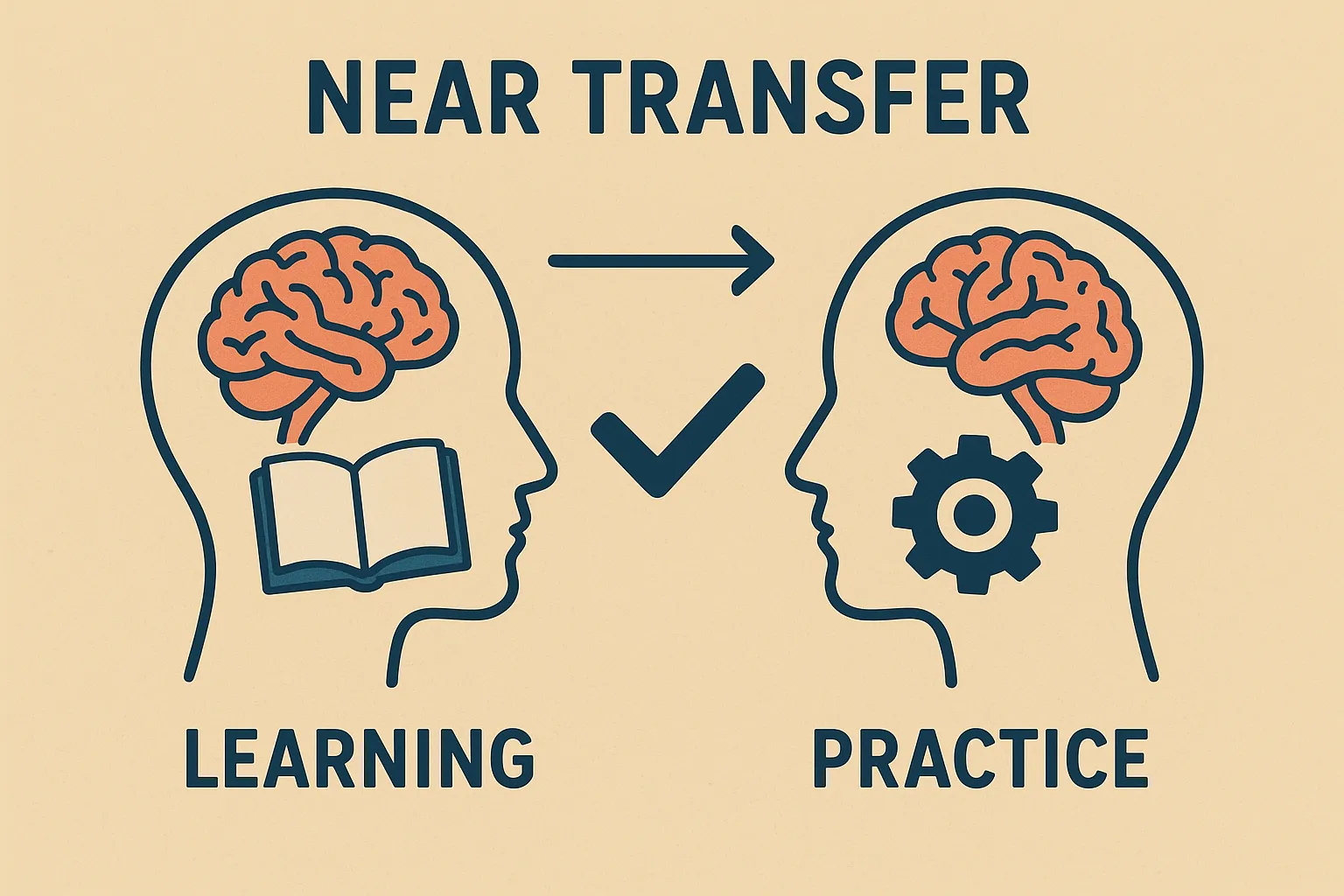
Near Transfer stems from a scientific study in neuroscience conducted by Barnett & Ceci (2002). Its central lesson is simple to state and heavy with consequences: immediate practice makes learning far more effective and durable. The shorter the interval between acquiring a piece of knowledge and putting it into application, the better that knowledge anchors and transfers to nearby situations.
Applied to a Problem Solving approach, this principle translates into two concrete requirements.
Solve problems the moment they appear
Resolution must happen as early as possible, the instant the problem surfaces, not in two weeks, not in two sprints. It’s at the moment when the context is still hot, when the conditions of the problem are right there in front of everyone, that learning is richest.
This means mobilizing everyone connected to the problem. Each person left out is a person who potentially won’t be able to draw any learning from the situation. The goal isn’t just to fix things: it’s to ensure that those who experience the problem are also the ones who understand and solve it, because they’re the ones who’ll get the most out of it.
Share and apply the learnings without delay
Solving isn’t enough: you have to spread it. And here again, speed is decisive. Whether through a Kaizen session, mob programming, or a kata, the challenge is to turn the resolution into shared practice while the context is still fresh. The more closely collective practice follows resolution, the more the learning propagates and takes root in the team.
Every problem, a learning opportunity
This is the whole reversal that Near Transfer brings about: it shifts a problem from being a task to clear away to being a learning opportunity to seize immediately. Where a backlog turns problems into depreciating stock, Near Transfer turns them into chances to move the team forward, provided you don’t let time do its work of erosion.
Mobilize the right people at the right moment, solve on the spot, share without delay. Every problem then becomes a lever for continuous progress, not only for the team directly concerned, but for the entire company. That’s how a Problem Solving culture stops being wishful thinking and becomes a mechanism of permanent improvement.