We like to believe a tech product is won through technical feats. Yet I’ve watched enough brilliant teams fail to draw a simple conviction from it: technical excellence alone isn’t enough to make a product succeed. All the expertise in the world is worthless if the effort is pointed in the wrong direction. Without a product vision or a fitting organization, you build fast and well… things nobody wants.
The reverse is just as true. Succeeding with a tech product without deep technical mastery is wishful thinking. A flawless organization built on fragile code that’s slow to evolve and riddled with regressions will stall sooner or later. Success therefore lies neither on one side nor the other: it lies at the crossroads of the two.
Two excellences for one goal
The success of a tech product rests on the interplay of two forms of excellence, complementary and inseparable.
Technical excellence
This is the ability to produce software of high quality, with a high level of productivity and agility. It comes mainly from and is inspired by Software Craftsmanship: automated tests, careful design, continuous refactoring, readable and modifiable code. It’s not a pursuit of gratuitous perfection, but the condition for staying fast over the long run. Code you’ve mastered is code you can evolve without fear and without breaking everything.
Organizational excellence
This is the organization’s ability to direct that technical power to the right place: a fine-grained understanding of user needs, a short time-to-market, the centralization of learnings, and the continuous valuing of cross-cutting improvements. It’s what guarantees you build the right thing, at the right time, for the right people.
Both serve the same goal: operational excellence, that is, the ability to quickly deliver real value on well-identified needs.
Operational excellence = technical excellence + organizational excellence
Move fast AND well, not fast OR well
Too often, the situation is framed as a trade-off: move fast or do it well. You’d have to pick a side, sacrifice quality to go faster, or slow down to do things right. It’s a false dilemma, and it’s probably one of the most costly traps for a tech team.
The real key to long-term success lies precisely in refusing that choice: move fast and well. The two aren’t opposed; they reinforce each other. Technical quality is what lets you stay fast over time; delivery speed is what lets you learn fast and adjust course before you’ve been wrong for too long.
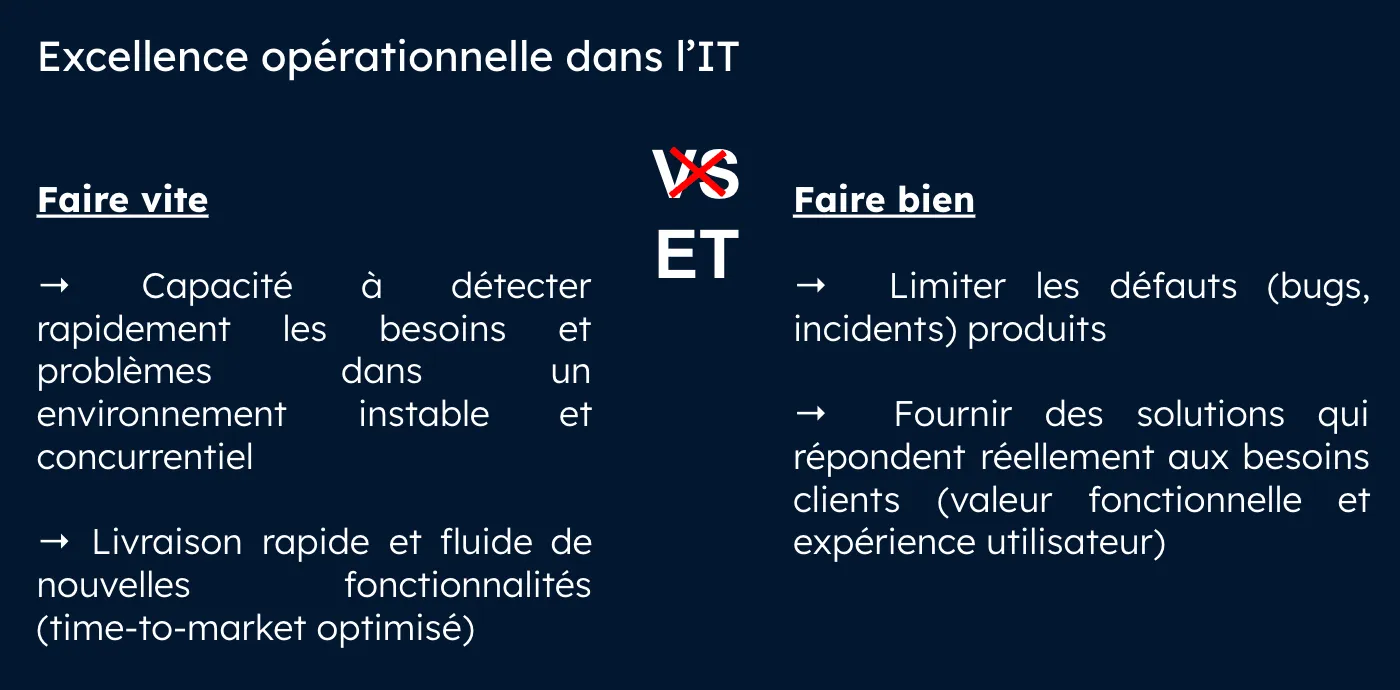
This tension between the two dimensions can be summed up like this:
| Move fast | Do it well |
|---|---|
| Quickly detect needs and problems in an unstable, competitive environment | Limit the product’s defects (bugs, incidents) |
| Deliver new features quickly and smoothly (optimized time-to-market) | Provide solutions that genuinely meet customer needs (functional value and user experience) |
Set side by side, these two columns don’t describe two competing strategies but two sides of the same ambition. The “VS” we usually write between them should be crossed out and replaced by an “AND”.
Lean Management as a framework
How do you hold both ends at once? There’s no need to reinvent the method: Lean Management, born from the Toyota Production System, has proven itself over nearly a century at achieving exactly this goal. Originally designed for industry, its foundations transpose remarkably well to building software products. It rests on a few structuring principles.
A culture of continuous improvement and problem-solving
Lean doesn’t chase the great leap forward, but permanent improvement in small steps. Every problem encountered isn’t a failure to hide but raw material for progress: you trace it back to the root cause rather than patching the symptoms. This discipline of kaizen installs a dynamic in which the organization learns continuously.
Quality as the norm, built in at the source
Rather than inspecting quality at the end of the line, Lean creates the conditions that place it at the heart of the company, as a norm and not an option. Quality is built at every step, not after the fact. This is exactly the spirit of Software Craftsmanship: you don’t clean up the code once it’s in production, you do it right as you write it.
An optimized workflow and just-in-time
Lean makes the organization converge toward an optimized workflow that reduces waste, the famous mudas. It promotes work done just-in-time: you produce what’s needed, when it’s needed, not before, not after. This avoids overloading teams, accumulating work in progress, and building features whose need hasn’t yet been confirmed.
The end user’s satisfaction as an obsession
Everything, ultimately, converges toward a single arbiter: the end user. Their satisfaction isn’t one indicator among many; it’s the obsession that aligns technical and organizational decisions. It’s what settles the trade-offs and gives concrete meaning to the value you claim to deliver.
Conclusion
Technical excellence and organizational excellence aren’t two options to choose between: they’re the two halves of a single equation. One without the other leaves a team either fast but misdirected, or relevant but unable to move forward. It’s their sum that produces operational excellence, that ability to quickly deliver real value on well-identified needs.
Lean Management offers a proven framework for getting there, by knocking down the false dilemma of “fast or well”. The real question is never which one to sacrifice, but how to build an organization and a technical culture that allow for both at once.